Shipping Bill Closure for E-Commerce Exporters: Process, Charges & Exchange Rate (RBI Update)
Introduction
With the rapid growth of e-commerce exports, especially through platforms like Amazon Global, Indian exporters are increasingly using fulfillment services such as FBA (Fulfillment by Amazon). However, along with this growth comes compliance requirements—one of the most critical being Shipping Bill (SB) Closure.
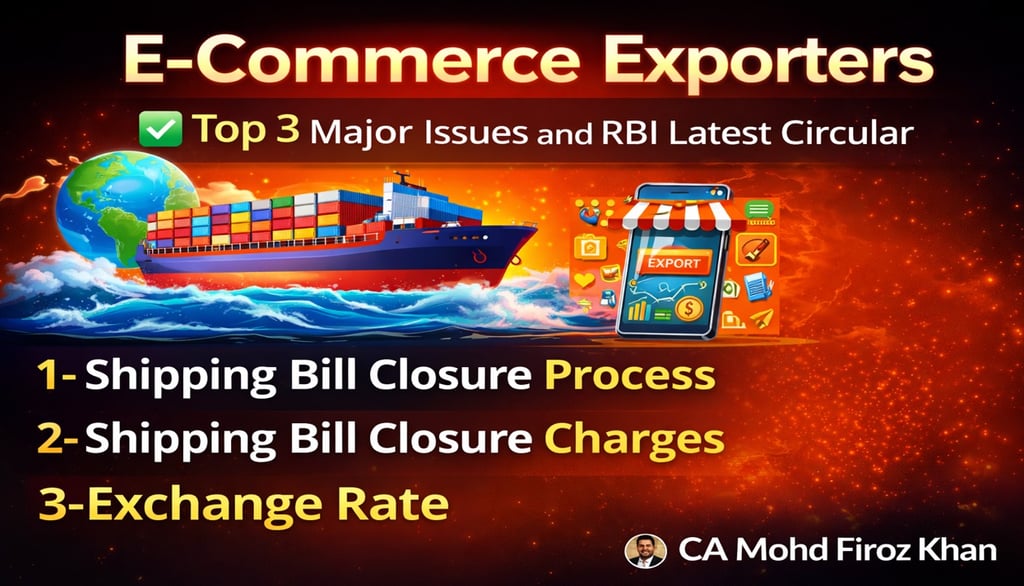
In this blog, we’ll cover:
Shipping Bill Closure Process
Charges involved
Exchange rate considerations
Top issues faced by exporters
Understanding the E-Commerce Export Flow
In a typical e-commerce export transaction:
Goods are sent by the Indian exporter to overseas warehouses (like Amazon FBA in the USA).
Logistics providers such as DHL, FedEx, or UPS handle delivery.
The goods are delivered to foreign buyers via platforms like Amazon.
Payment is received through Payment Service Providers (PSPs) such as:
PingPong
Skydo
HSBC
The funds are credited to the exporter’s AD Bank (Authorized Dealer Bank) in India.
What is Shipping Bill Closure?
Shipping Bill Closure is the process of reconciling export proceeds with the shipping bill filed at customs. It ensures that:
Export proceeds are realized in India
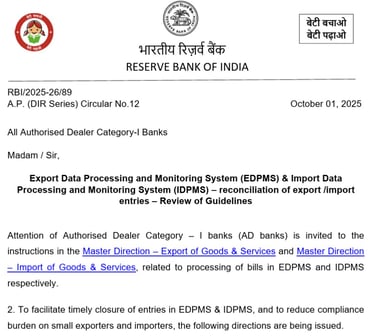
Transactions are reported correctly in the EDPMS (Export Data Processing and Monitoring System) of RBI
Shipping Bill Closure Process (E-Commerce Export)
Step-by-Step Process:
Export Shipment
Goods exported and Shipping Bill generated.
Payment Realization
Payment received via PSPs (PingPong, Skydo, etc.).
FIRC Generation
FIRC (Foreign Inward Remittance Certificate) issued by bank/PSP.
Document Submission to AD Bank
Exporter submits:Shipping Bill copy
FIRC
Airway Bill
Mapping Sheet (SB No. with FIRC/IRM No.)
Bank Verification
AD Bank verifies documents and matches export proceeds.
EDPMS Closure
Bank updates RBI system and closes the Shipping Bill.
Documents Required for SB Closure
Shipping Bill (SB No.)
FIRC
IRM (Inward Remittance Message)
Airway Bill
SB-FIRC Mapping Sheet
Shipping Bill Closure Charges
Charges may vary depending on:
Bank policies
PSP involvement
Volume of transactions
Typical Charges Include:
Bank processing fees
FIRC issuance charges
Documentation handling fees
Exporters should confirm charges with their AD Bank or PSP beforehand.
Exchange Rate Considerations
Exchange rates play a crucial role in export accounting and compliance.
Key Points:
RBI guidelines must be followed for exchange rate conversion
Banks apply their own TT buying rate
Differences may arise between:
Invoice value
Realized amount
Top 3 Major Issues Faced by Exporters
1. Mismatch in SB & FIRC
Incorrect mapping between shipping bill and remittance
Leads to delay in closure
2. Delay in Payment Realization
Payments through PSPs may take time
Affects compliance timelines
3. Documentation Errors
Missing or incorrect details in:
Airway Bill
FIRC
Mapping sheet
▶️Need Expert Assistance?
Navigating these changes can be complex. MF Khan & Associates is here to assist you with expert chartered accountancy services in both the UAE and India.
ecommerce export india,export remittance explained,shipping bill closure process,payment gateway export remittance,ad bank export remittance,export payment reconciliation,paypal export payment india,shipping bill closure ad bank,ecommerce export compliance india,export documentation india,export import training,ca.mfkhan,Bank charges for closing shipping bill,Bank process for edpms,Closure of shiping bill,Edpms process,What is edpms,skydo payment gateway,export
📌Connect With Our Tax Experts
This information is provided by CA M.F.KHAN – Tax Expert.
For expert chartered accountancy services tailored to your international needs, connect with us: www.camfkhan.com