🎯Navigating the UAE's New E-Invoicing Mandate: Timelines and Penalties Explained
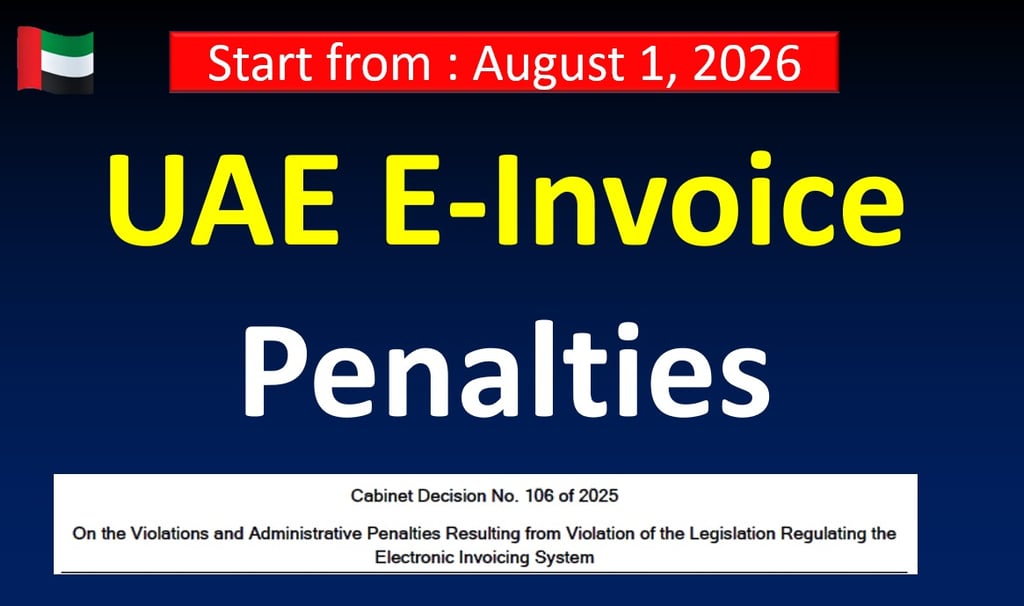
The UAE is taking significant steps to digitize its tax and business ecosystem with the introduction of a mandatory Electronic Invoicing System, starting from August 1, 2026. This major shift aims to streamline operations and ensure compliance across the board.
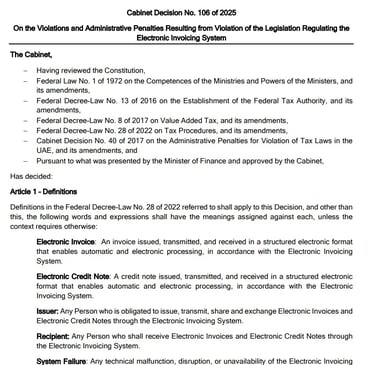
To help businesses prepare, here is a comprehensive breakdown of the rollout schedule, compliance requirements, and the penalties for violations outlined in Cabinet Decision No. 106 of 2025.
📅 Mandatory Implementation Timelines
According to the guidelines (MD No. 243 of 2025 and MD No. 244 of 2025), the mandatory rollout will take a phased approach based on a business's annual revenue. Entities will need to select an Accredited Service Provider (ASP) and fully implement the system by specific deadlines.
For Entities with Annual Revenue ≥ AED 50,000,000:
Last date to appoint an ASP: 31st July 2026
Last date to implement the Electronic Invoicing System: 1st January 2027
For Entities with Annual Revenue < AED 50,000,000:
Last date to appoint an ASP: 31st March 2027
Last date to implement the Electronic Invoicing System: 1st July 2027
⚠️ Violations and Administrative Penalties
To ensure strict adherence to the new system, Cabinet Decision No. 106 of 2025 clearly defines the violations and their corresponding administrative penalties. It is crucial for both issuers and recipients to understand these potential fines:
Failure to Implement: If the issuer fails to implement the Electronic Invoicing System or fails to appoint an ASP within the timeline, the penalty is AED 5,000 for each month of delay (or part thereof).
Failure to Issue/Transmit E-Invoices: If the issuer fails to issue and transmit an e-invoice to the recipient on time, the fine is AED 100 per invoice, capped at a maximum of AED 5,000 per calendar month.
Failure to Issue/Transmit E-Credit Notes: Failing to issue and transmit an Electronic Credit Note on time incurs a penalty of AED 100 per note, up to a maximum of AED 5,000 per calendar month.
Issuer Failing to Notify System Failure: If the issuer fails to notify the Authority of a system failure within the prescribed timeline, they face a fine of AED 1,000 per day of delay (or part thereof).
Recipient Failing to Notify System Failure: Similarly, if the recipient fails to notify the Authority of a system failure on time, the penalty is AED 1,000 per day of delay (or part thereof).
Failure to Update Registered Data: If either the issuer or recipient fails to notify the appointed ASP of changes to their registered data on time, the penalty is AED 1,000 per day of delay (or part thereof).
▶️Need Expert Assistance?
Navigating these changes can be complex. MF Khan & Associates is here to assist you with expert chartered accountancy services in both the UAE and India.
uae einvoice penalties, uae einvoicing 2026, uae tax penalties, uae corporate tax update, uae vat update, uae einvoice fine, uae fta update, federal tax authority uae, uae business compliance, dubai tax update, uae tax alert 2026, einvoicing uae mandatory, uae mainland compliance, uae free zone tax update, uae tax news, uae corporate tax news, emaratax update, uae vat penalties, uae accounting update, dubai business news, uae tax consultant update, uae penalty rules, uae invoice rules 2026, uae tax training, uae business alert
📌Connect With Our Tax Experts
This information is provided by CA M.F.KHAN – Tax Expert.
For expert chartered accountancy services tailored to your international needs, connect with us: www.camfkhan.com
